
By clicking below you will be redirected to the JLens ETF website
JLens is a nonprofit and Registered Investment Advisor that empowers investors to align their capital with Jewish values, and advocates for Jewish communal priorities in the corporate arena. JLens’ Jewish Investor Network is composed of over 35 Jewish institutions, representing $12 billion in communal capital, as of June 30, 2025. JLens has been an affiliate of ADL (Anti-Defamation League) since 2022.
JLens engages with approximately 500 of the largest U.S. public companies on behalf of Jewish institutional and individual investors, using shareholder advocacy tools including dialogue with management, proxy voting, filing shareholder proposals, and public advocacy campaigns. JLens’ research and advocacy is focused on combating antisemitism and hate, supporting Israel, and engaging in Tikkun Olam (repairing the world). This report shares the highlights of JLens’ activities from January 1, 2024, to June 30, 2025.
In February 2025, JLens helped launch an exchange-traded fund (ETF), listed on the New York Stock Exchange, which is designed to track the JLens 500 Jewish Advocacy U.S. Index. The Fund’s advisor is ETF Architect, while JLens is the sub-advisor and sponsor.
The Index consists of the 500 largest U.S. public companies, excluding companies whose activities do not align with criteria informed by Jewish communal considerations, as defined by JLens’ index methodology. The remaining companies are then assessed based on their performance on Jewish values scorecards. The Index aims to deliver performance comparable to other U.S. Large Cap indexes.
For more information, visit investjewishly.org

Helped launch a Jewish advocacy ETF on the New York Stock Exchange.

Achieved 46.8% independent shareholder support for JLens’ proposal to curtail antisemitism and hate on Meta’s platforms — the top-performing human rights proposal of the 2025 proxy season.

Opposed four anti-Israel shareholder proposals filed at major U.S. tech and defense companies, with all four receiving less than 10% shareholder support.
A shareholder proposal filed by JLens demanding Meta addresses antisemitism and hate content on Facebook and Instagram received 46.8% support from independent investors. While Meta’s dual-class share structure gives CEO Mark Zuckerberg 61% voting power, resulting in only 14.6% overall support, the strong independent shareholder backing demonstrates investor concerns about online hate. The proposal, endorsed by both major proxy advisory firms, called for a public report evaluating Meta’s content moderation policies and effectiveness in addressing online antisemitism, anti-LGBTQ+, and anti-disability hate. JLens refiled the proposal in 2026 to continue pressing Meta for transparency and accountability.

Following engagement with JLens and ADL, major video game publishers Electronic Arts and Take-Two Interactive strengthened their community standards to explicitly address extremism and terrorism in online gaming platforms. EA, publisher of popular titles such as Madden NFL and Apex Legends, updated its Positive Play Charter, while Take-Two subsidiaries Rockstar Games and 2K enhanced their Codes of Conduct with more detailed prohibitions on hate speech and extremism. These policy changes followed ADL safety audits and aligned with research showing that hate speech drove away female players, new players, and casual players among the over 100 million people in the U.S. who played online games, potentially impacting the industry’s financial growth.

JLens encourages companies to support Jewish Employee Resource Groups (ERGs), which play a critical role in combating antisemitism and empowering Jewish identity at work. JLens welcomed Steven Phillips from JewishERGs on a panel, alongside legal experts, on Countering Antisemitism and Anti-Zionism at Work at ADL’s Never Is Now summit, and in a guest blog post where he shared the challenges Jewish ERGs face, and why their presence is essential in today’s corporate world.
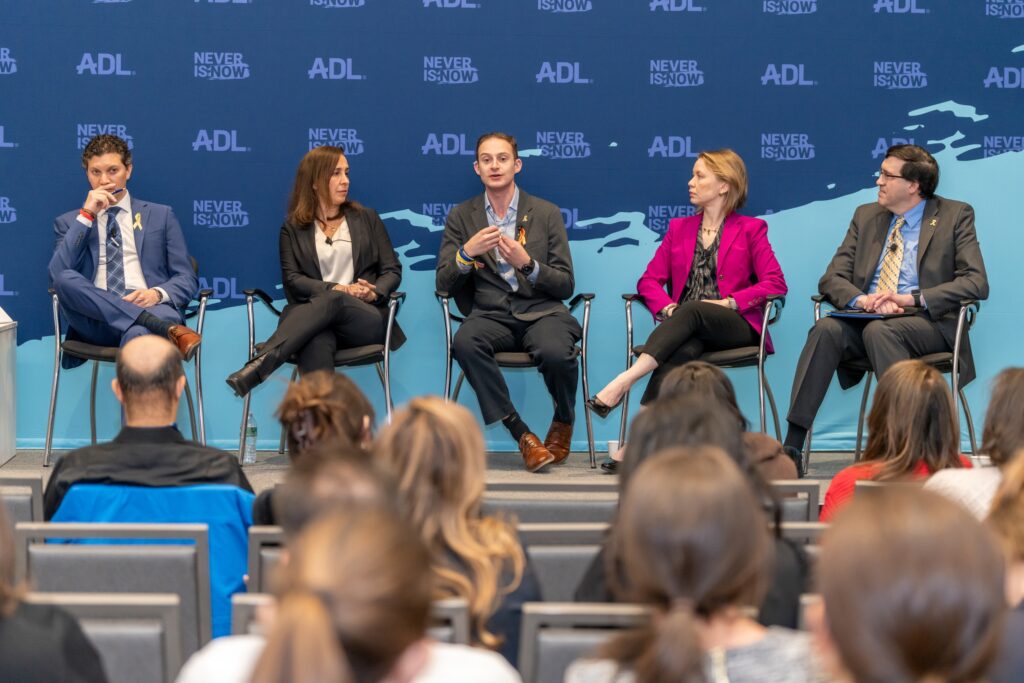
JLens published a report which addresses growing workplace discrimination for Jewish employees since October 7, 2023 and advocates for corporate policy changes. An ADL study suggested that job seekers with Jewish sounding names would need to send 24% more applications than applicants with Western European sounding names to receive equivalent responses. Alleged high-profile incidents at companies like Amazon and Alphabet could have contributed toward hostile environments, while Jewish Employee Resource Groups often receive less funding than other ERGs. JLens recommends companies implement zero-tolerance antisemitism policies, adequate Jewish ERG support, and provide religious accommodations.

Citigroup has demonstrated meaningful commitment to Jewish inclusion by offering antisemitism awareness workshops, hosting a company-wide Passover celebration and providing managers with a guide to the Jewish High Holidays. Citi recently launched an interfaith ERG and has affirmed that religious intolerance has no place at the company.
Citi was one of the recipients of JLens’ 2024 Corporate TOV Awards.
In fall 2024, as students were returning to campuses amid renewed anti-Israel protests, JLens released a report, The Impact of Israel Divestment on Equity Portfolios: Forecasting BDS’s Financial Toll on University Endowments. This was a first-of-its-kind study that comprehensively quantified the financial implications of BDS aligned investment strategies for universities. The study found that the 100 largest U.S. university endowments could collectively forgo $33.2 billion in returns over the next decade if they acquiesce to protestor demands to divest from Israel. Students and alumni across the U.S. utilized the findings to combat these calls for divestment. JLens presented its report findings to a group of university administrators and hosted a webinar with leading expert on university fiduciary duty, Professor Max M. Schanzenbach, Professor of Law at Northwestern University.

Proxy Season 2024
During the 2024 proxy season, JLens, in collaboration with ADL, urged shareholders to vote against anti-Israel shareholder proposals filed at tech and defense companies, which aimed to advance BDS-aligned narratives. At Amazon, JLens opposed Proposal 6, which sought to end the $1.2 billion Project Nimbus cloud computing agreement with the Israeli government. JLens and ADL filed a Notice of Exempt Solicitation with the SEC and conducted extensive shareholder outreach, warning that such language emboldens antisemitism and seeks to delegitimize Israel. A similar proposal received 34% support in 2023, but following JLens’s efforts and ISS switching its recommendation from FOR to AGAINST, the resolution received just 16% support in 2024. At RTX, another anti-Israel proposal alleged the company’s arms sales to Israel are “used to maintain the system of apartheid.” In the view of JLens, the proposal sought to deprive Israel of essential defensive tools, including the Iron Dome system. Following JLens’ campaign to vote against Proposal 7, it received only 5.48% support. Neither proposal was successfully refiled in 2025.
Proxy Season 2025
In 2025, JLens opposed anti-Israel proposals at four major defense and tech companies, emphasizing the distinction between legitimate human rights concerns and the politicization of ESG frameworks to target Israel. In each case, JLens helped educate proxy advisory firms and major institutional shareholders about the intent of these proposals, with ISS and Glass Lewis recommending against all four. Each proposal received low support and some failed to meet the SEC’s 5% resubmission threshold for 2026.
In September 2025, a coalition of leading pro-Israel and Jewish organizations — JLens, ADL, AJC and the Jewish Federations of North America — announced its support for important steps taken by investment-services firm MSCI to ensure neutrality and mitigate the risk of bias in its ESG Controversies products. The coalition was satisfied that MSCI does not support or endorse the anti-Israel BDS movement, and it appreciated the concrete steps the company has taken. The engagement was initiated by JLens, which utilizes MSCI data in the construction and management of the JLens 500 Jewish Advocacy US Index.

JLens examined how ESG (environmental, social, governance) investment funds may conflict with pro-Israel investors’ values. JLens analyzed 15 major U.S. large-cap ESG ETFs and found that 13 screen out defense companies like RTX, Lockheed Martin, and General Dynamics—which supply critical defense systems to Israel, including the Iron Dome. Additionally, some ESG funds support anti-Israel shareholder proposals through proxy voting, including proposals targeting companies’ relationships with Israel. JLens believes that these funds’ goals may conflict with Israel’s right to defend its citizens and Jewish values emphasizing self-defense.

JLens highlighted major corporations making significant contributions to Israel’s economy and society (all data as of May 1, 2025). Intel has invested NIS 20 million in national initiatives, including math education programs supported by 6,000 employee volunteers. Alphabet launched a $25 million five-year program targeting underrepresented communities including ultra-Orthodox, Arab professionals, and women. Microsoft provides digital literacy training through its Imagine Academy framework. Western Digital volunteers deliver coding classes in Hebrew and Arabic to underrepresented students, while Cisco’s Network Academy educates 4,000 students and invests in Palestinian-Israeli technology partnerships. JLens engages with companies to ensure they are aware that shareholders value their presence in Israel and encourages social impact work there.

JLens published an investor whitepaper analyzing two UNHRC outputs—a Special Rapporteur report submitted to the UNHRC and a forthcoming updated business database—that could amplify BDS-aligned pressure campaigns against multinational firms with ties to Israel. These efforts, while framed in human rights language, are based on flawed and politicized claims. Left unchallenged, they risk misleading investors, distorting corporate risk profiles, and legitimizing antisemitic agendas. JLens offered this analysis to help investors and companies proactively address the reputational, legal, and strategic implications.

JLens published an investor whitepaper examining Norway’s $1.7 trillion sovereign wealth fund, revealing that, as of December 31, 2024, Israeli companies face the highest exclusion rate — 32% — in the fund’s 63-country, 8,659-holding equity portfolio, despite the fact that two major human rights indexes give Israel higher scores on human rights issues than many of the other countries in which the fund remains invested. Companies from countries with authoritarian regimes that have far lower human rights scores, such as China and Qatar, face minimal or no exclusions. Chinese companies have an exclusion rate of about 2%, and companies from Qatar and Türkiye face a 0% exclusion rate, despite serious human rights violations in those countries. This stark disparity calls into question the consistency of the fund’s ethical guidelines.
The Jewish tradition deeply values the welfare of children. The Babylonian Talmud writes “the world endures only for the breath of school children”(Talmud Bavli, Shabbat 119b), emphasizing our duty to the next generation. JLens is an active member of the Child Safety & Tech Coalition, collaborating with peer investors to help strengthen online safety standards.
In 2024, JLens joined a group of fellow investors in urging shareholders to vote in favor of a shareholder proposal on Meta’s ballot that called on the company to address critical issues of hate speech and cyberbullying as well as other issues related to protecting kids on its social media platforms. According to a 2024 survey conducted by the ADL Center for Technology & Society (CTS), 50% of teens ages 13 to 17 reported experiencing online harassment. Of those teens, 61% experienced that harassment on Facebook, more than X, WhatsApp, Youtube and Telegram and 39% reported experiencing harassment on Instagram. This proposal received 18.5% of the vote, which is equal to 59.1% of the non-insider vote. The result of this vote signaled to the company’s leadership that shareholders care deeply about this issue.
In 2025, JLens voted FOR Proposal 14 at Alphabet, which requested a report on child safety impacts and harm reduction to children on its platforms, specifically YouTube. In the proponent’s rationale for this report, they highlight that YouTube puts children at risk for cyberbullying, depression, self-harm, suicide, and even sexual exploitation. The proponent states that investors and stakeholders cannot verify Alphabet’s claims to improve child safety on YouTube without publicly available harm reduction performance metrics provided in a report. The proposal received 9.3% of the total shareholder vote, which when you account for independent shareholders only, it received 24.5% of vote.

In the 2025 proxy season, JLens, along with many other institutional investors, voted against members on the nominating and governance committees at numerous companies that maintained dual-class voting structures with unequal voting rights. Dual class structure allows a company to issue multiple classes of stock with unequal voting rights. Classes of stock with superior voting rights, which are typically owned by founders and executives, have no greater economic interest in the company but carry superior voting interests. The most notable application of this policy was JLens’ vote against the Meta CEO and director Mark Zuckerberg, who has 61% of total voting power at Meta, despite his economic stake being far lower than his voting power. JLens also voted in support of Proposal 6 to eliminate the dual class voting structure at Meta, which received 25.8% of the total shareholder vote and 82.4% of the independent shareholder vote.
In another application of this policy at DoorDash, JLens voted against the election of director John Doerr (Proposal 1b). DoorDash began trading on the New York Stock Exchange nearly five years ago, and has since not issued any time-based sunsets for its multi-class structure. JLens marked its dissatisfaction with the company’s class structure by voting against the director John Doerr, who is Chair of the Nominating and Corporate Governance Committee. JLens notes that dual and multi-class share structures hinder directors’ accountability to their company’s shareholders and believes each share should carry one vote. The director received 87.8% of the total shareholder vote, while all other DoorDash directors received an average shareholder vote of 94.8%.


U.S. public companies researched and engaged by JLens

investor coalitions that JLens is involved in

data points evaluating companies gathered annually
Harnessing the power of corporations to combat antisemitism & hate, supporting Jewish and minority employees, and ensuring that products and services are free from antisemitism.
Countering BDS pressure on corporations and investors, removing anti-Israel bias from the financial services industry, and encouraging economic ties with Israel.
Jewish investors have a responsibility to help repair the world. JLens collaborates with other faith-based investors to protect children online, end forced labor, and promote responsible business practices.